Overview
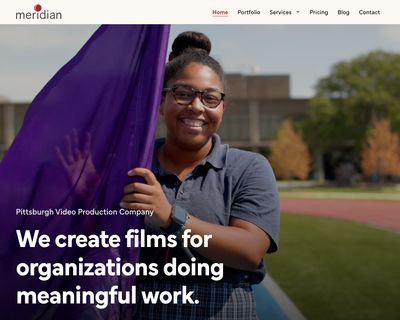
Meridian Media is a Pittsburgh-based video production company creating cinematic work for educational institutions and nonprofit organizations. Their existing website was running on Concrete, an aging CMS increasingly prone to bugs, hosted on a shared server at a cost that wasn't justified by the editing experience it provided. The design hadn't kept pace with the quality of their portfolio, and updating content required workarounds that made independent publishing frustrating.
I led the end-to-end redesign and migration: from planning and content architecture through UX/UI design, AI-assisted development, CMS configuration, and launch.
Challenges
Three compounding issues were limiting the site:
An aging CMS creating friction
Concrete had become unreliable. Bugs in the editing interface made routine content updates more effortful than they should be, and the platform was increasingly out of step with modern web tooling.
A design that undersold the work
The existing site's visual design didn't reflect the cinematic quality of Meridian's portfolio. A video production company's website is itself a pitch, and the site wasn't making it.
Hosting costs without corresponding value
The hosting plan was harder to justify given the editing experience and performance it delivered.
Goals
- Migrate to a modern, maintainable stack that would remain stable and low-cost for years
- Give the non-technical content manager a pleasant, independent editing experience with no developer involvement required for routine updates
- Redesign the site to reflect Meridian's refined focus on educational and nonprofit clients
- Protect existing SEO equity through a careful migration with no broken URLs
- Replace the existing sitemap and add SEO improvements the old site was missing: Open Graph tags and structured data
Solutions
Choose the Optimal Tech Stack
Eleventy (static site generator) + Sanity (headless CMS) + Netlify (hosting + forms)
This combination was chosen deliberately. Eleventy produces fast, lightweight static HTML with no runtime dependencies. Sanity provides a polished, flexible editing interface that non-technical users find intuitive. Netlify offers zero-cost hosting for static sites with built-in form handling and automatic deploys via webhook.
The result is a site with essentially no ongoing infrastructure cost, sub-second page loads, and a publishing workflow that rebuilds and deploys the entire site within 30 seconds of hitting Publish in the CMS.
Content Architecture & CMS Design
I designed the full Sanity content schema from scratch, defining document types, field structures, and relationships to reflect how Meridian thinks about their content. Key decisions included:
- A structured wedding packages schema with per-feature include/exclude toggles and add-on support, making the comparison table on the wedding service page fully editable without touching code
- A global site settings area managing values that previously required a code change to update, including the homepage demo reel Vimeo URL. Swapping the hero video now requires only a URL change in the CMS, with no redeployment.
- Dual-mode internal/external links in body content, so editors can link to other pages on the site by searching for and selecting the page by name, rather than typing or copying URLs that could break
The editing experience was configured with the content manager specifically in mind: clear field labels, sensible field ordering, and a structure organized around their editorial workflow.
UX/UI Design
What began as a visual refresh evolved into a more considered redesign. Working with AI-assisted development tools made it possible to iterate quickly, which created room to make bigger departures from the original design than initially planned and to invest more time in polish.
Meridian had recently sharpened their focus toward educational institutions and nonprofits, moving away from being a general-purpose production company. The redesign was targeted at that more specific audience. The visual direction aimed for warm and editorial while staying minimal enough to let the video and photography work remain the focus.
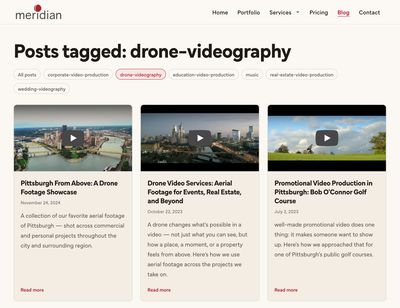
Typography received particular attention. With an increased emphasis on the blog as an SEO driver, a strong reading experience became a design priority, not just an aesthetic one. Type choices, sizing, and spacing were tuned to make longer-form content comfortable to read.
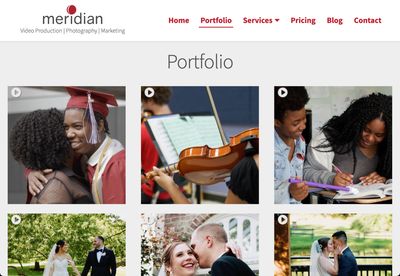
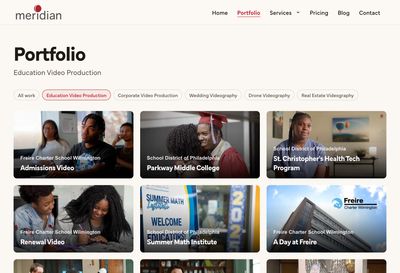
The portfolio page was a particularly important surface to get right. It's where potential clients evaluate the work, so the visual treatment, information hierarchy, and browsing experience all needed to reflect the quality of what it was showcasing.
Before
After
Other key design decisions included:
- A full-screen Vimeo background video hero on the homepage. The demo reel plays silently on loop in background mode, setting the tone immediately on arrival.
- A portfolio grid with client-side filtering by project type (Corporate, Education, Wedding, Drone, Real Estate, Photography), with no page reload and no framework overhead
- A blog with tag-based filtering, with tag index pages generated at build time for SEO-friendly URLs
- A wedding service page featuring a fully editable package comparison table rendered from structured CMS data
AI-Assisted Development
I used Cursor with targeted, context-rich prompts to accelerate the build while maintaining quality. Rather than using AI to generate generic boilerplate, I wrote prompts that incorporated the specific content schema, URL structure, SEO requirements, and design decisions already established, producing output that required minimal correction and fit the project from the start.
The speed this created had a compounding effect: time saved in development was reinvested in design iteration, resulting in a more refined outcome than the original scope anticipated.
SEO Migration & Improvement
Migrating an established site carries SEO risk if not handled carefully. I audited Google Search Console to identify every indexed URL, including edge cases like a blog post slug containing capital letters that most tooling would silently lowercase and break, and ensured every one resolved correctly on the new site.
Beyond preservation, the new site improved on what the old one had:
- A new sitemap.xml generated at build time and submitted to Search Console
- Open Graph tags on every page for proper social sharing previews
- LocalBusiness structured data (schema.org JSON-LD) for improved local search signals
- Enforced www to non-www redirect at the infrastructure level via Netlify, resolving a longstanding duplicate content issue where both versions of URLs had been indexed
Launch
DNS cutover was planned and executed with a safety net: the old hosting remained live until the new site was fully verified, with a documented rollback path if needed. The transition was seamless, with no downtime, no broken URLs, and no SEO disruption.
Impact
Meridian Media now has a site that:
- Reflects the quality and focus of their work, visually and technically
- Can be updated entirely independently by the business owner, with no developer involvement
- Costs a fraction of the previous hosting, with better performance
- Is built on a stack that will remain stable and maintainable for years
- Has stronger SEO foundations than the site it replaced
The content manager, who was new to headless CMS tools, was able to begin entering and publishing content in Sanity Studio with minimal onboarding. That was the clearest sign the editing experience had been designed well.
« Back to all work